I have a confession to make.
Truth be told, it’s one I have hoped to keep secret for as long as possible. I’ve kept it locked away in the shadows, never spoken of it to anyone, and hid the evidence whenever the truth threatened to come out. But I don’t think I can live like this anymore.
I…am a conlanger.
There. I said it.
Yes, one of my creative endeavors with Arcreonis is to create fictional languages. It’s ridiculous. It’s silly. It’s perhaps even self-aggrandizing.
But I don’t care. I’m doing it because I find it fun and challenging.
So today, with that off my chest at long last, I am sharing with you some tidbits from my first conlang, “Antotarah,” which will appear in my forthcoming first Arcreonis book, Shepherds of Chaos, as the language of the isle of Byrn–where the bulk of the book is set.
I want to create–in a limited form, mind you; I’m not crazy…!–multiple fictional languages for the various fictional cultures that will feature in Arcreonis.
Antotarah’s sound is loosely inspired by the Hindi and Nepali languages, and the script is inspired by Amharic, the language of Ethiopia. (Not-so-coincidentally, those are the two cultures that the nation of Byrn is based on.) I am by no means a linguistics expert, nor an expert whatsoever on Hindi, Nepali, or Amharic; I am merely an observer and a linguistic thief.
Here are some examples for those of you who are morbidly curious enough to read on.
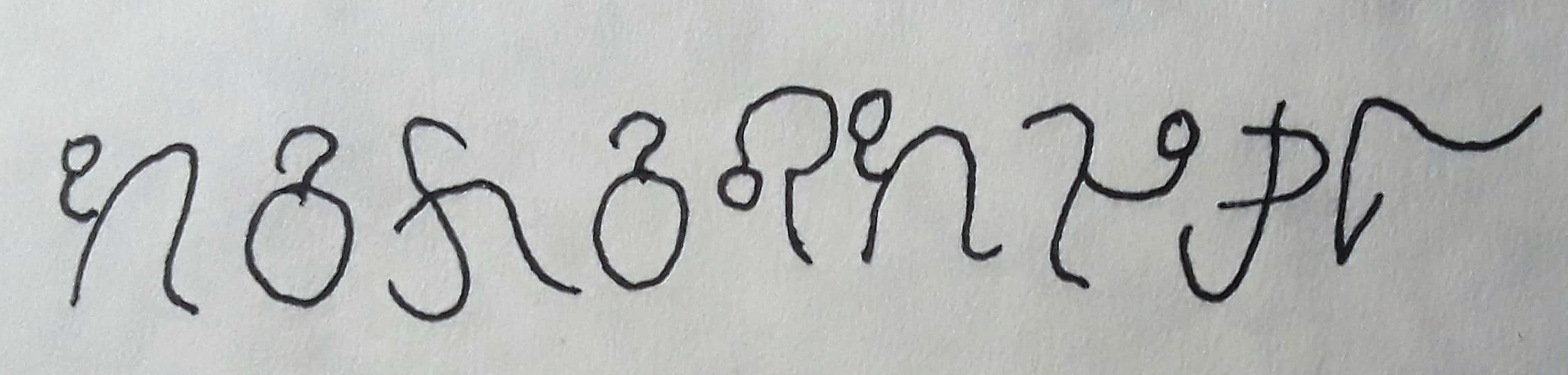
This above is Antotarah for “Arcreonis.” I don’t need to translate it really because it’s a pretty literal form of an already non-English word. I suppose a less-translated spelling would be “Arkreanis,” but that’s probably not something you were dying to know.

Now this is a fun one! This reads, “Hua Mieral’ku jareed tabt o Koyed Akunem jala“.
An English translation could read, “Hua Mieral’s journey to find the Lost Shepherd.” Or more literally, “Hua Mieral’s journey to the Lost Shepherd find,” given the sentence structure of Antotarah.
I want this sentence, or at least a form of it, to feature in the chapter headings of the chapters in Shepherds of Chaos that deal primarily with Mieral, the main character who is from South Byrn. It pretty much explains what her mission is at the start of the book, so it feels rather appropriate. And unless my handwriting improves by then, I’ll get somebody else to ink it and make it look ancient and mythic, because I dig those vibes.
I don’t know whether any of you will enjoy reading these “teasers” about Arcreonis, my upcoming epic fantasy series, but it occupies a big part of my head. If these sorts of things are appreciated, maybe I’ll do more of them.

For now, as this message says, “You will have to wait”!
This is read as “piit ,ago lim t*eh“. (Literally, “You will must wait,” as awkward as that sounds!)
The low mark (,) before the verb “ago” (will/shall) denotes a future tense. A high mark (`) would denote a past tense, while leaving it blank would denote present tense. Tense in Antotarah is indicated verbally by rising or falling inflection in the vowel of any given verb (loosely inspired by the ever-present tones in Mandarin Chinese, of which I have a basic 101 understanding). Rising inflections indicate future tense and falling inflections indicate past tense. Flat inflection indicates present tense. So the placement of the mark–either low or high–tells you whether to start at high or low pitch.
So, in reading “,ago”, since it has a low mark, one would start with a low pitch and rise to a high pitch.
Other tidbit: for whatever reason–since languages are allowed to do silly things for no good reason–I spell the “g” in “ago” with the Antotaran character for “j”, which I decided can do either sound depending on the context. English does that sort of thing all the time, so I’m in the clear, right? (No one will know that I just forgot to design a dedicated character for the “g” sound and didn’t want to design another one. Some secrets should stay hidden…)
Last tidbit: the * next to the T in “t*eh” is my rudimentary method of differentiating it from a standard T, as this type of T is meant to be sounded with the tongue curled back on the roof of the mouth. This probably comes more easily to speakers of Hindi and similar languages than it does to me!
And there you have it! My dirty secret has finally been brought to light and unleashed upon the world. (Much like the fact that I write books at all, I suppose…) Hopefully you found it fascinating.
 arcreonis.com