

There’s been an increasing push in the last half-decade or so for the normalization of “gender neutral language.”
I’m not going to be addressing the merits of that push in this article, but let me preface my words by saying that I acknowledge that there are indeed merits. What I’m talking about today is the major downside that these efforts are bringing upon the English language.
And maybe “major” is too strong a word. I’m of course speaking from my own experience and opinion, but there’s a part of me that feels others just aren’t seeing the potential problems that I’m seeing. And if they are, maybe they’re seeing a solution that I’m not seeing.
The English language, unlike some languages, does not traditionally have a commonly-used pronoun that is both gender neutral and singular. We do have one that is gender neutral and plural, which is: “they” (and its other forms, such as “them”). We’re missing out on a piece of language that is fairly important. What we’ve seen an increasing push for is for English to produce such a pronoun, and since we aren’t usually in the business of inventing totally new words, the English-speaking world has apparently collectively decided that we’ll start to use “they” as a singular pronoun.
Phew, we’ve rectified one big failing of the English language, right?
I’m here to beg to differ!
Now, I know what you’re thinking. “Just because the word ‘they’ has traditionally been used only to describe plurality doesn’t mean we can’t retrain our brains to think of it as either singular or plural. You’re just being a grammar-grandpa stubbornly holding onto the past because ‘that’s the way it’s always been done!'”
Well, I hear you. But let me tell you that that is not the case.
Here’s the thing. Other languages with gender neutral pronouns have extra rules and words that we don’t. For example: in Mandarin Chinese, the word for “him/her” is “ta.” It’s always gender neutral in spoken language, and it’s also always gender neutral in written language unless it’s specifically written with the “female” radical.
To make a word or pronoun plural in Chinese, the suffix “-men” is added. To say “him/her (gender neutral)” you say “ta,” and to say “them (plural)” you say “tamen.”
I’m not a linguist, so I don’t know how it works in most other languages. But I think Chinese uses a pretty sharp system here.
So what’s the problem that I have with using “they” as a singular pronoun? What’s the issue with changing the English language to force a plural pronoun to be singular too?
It means we no longer have a way to distinguish between singular and plural!
I’m not saying that “they” can never be used in a singular context. There are times and places where we can do that without causing confusion. Shakespeare apparently used it in his day, so it isn’t as if it’s unprecedented. Assuming we don’t know the gender of a new coworker we have yet to meet, for example, we might say, “I’d like to get to know them.” This is specifically in the context of talking about an individual person, and we’re only using the pronoun “them” because we don’t know whether that person is male or female. It would generally be impolite to assume the sex of a person whose sex we haven’t yet learned.
But that’s the thing–it isn’t confusing only when it’s placed in a very specific context. If we try to use it willy-nilly as if it fits just as well as a regular, singular pronoun, we’re going to cause inevitable confusion.
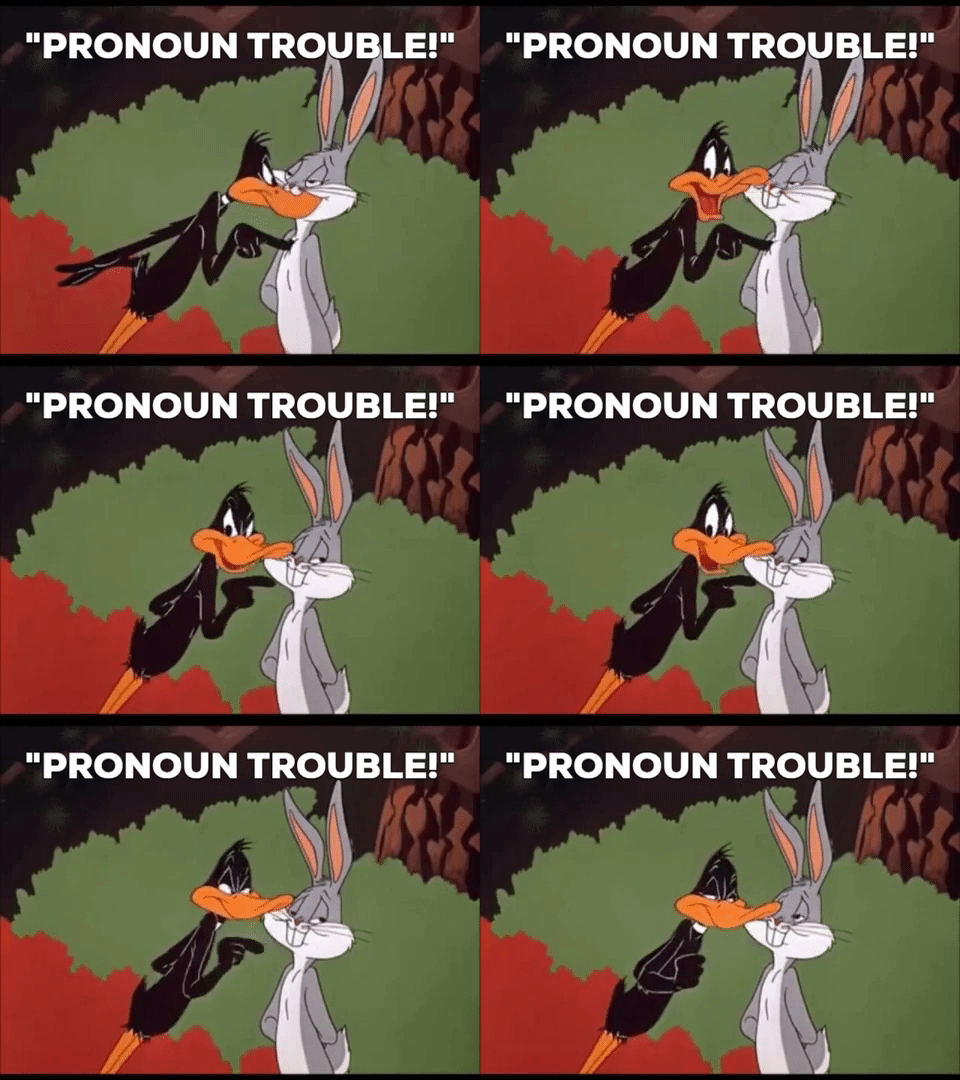
Now would be a good time to clarify that English does, in fact, have a pronoun that is both singular and gender neutral: “it.” We generally don’t use that word to refer to people, however, because it carries a heavy connotation of dehumanization. We’ll say “it” to refer to things and animals and sometimes infants, but we tend not to use it on people because it feels rude, somehow.
But here’s the thing. It would be better to decide we’re going to forgo that negative connotation and work with “it” as our de facto singular/gender neutral pronoun anyway, rather than use “they” and thereby destroy the meaning of the only plural pronoun we have.
To illustrate these hazards, here are some short passages from a book I have been reading: Rhythm of War by Brandon Sanderson. In these quotes, “they” is used as a singular pronoun to refer to a non-human character called “the Sibling”:
“I can hear you, a voice said in [Navani’s] mind–quiet, like a whisper. She couldn’t tell if it was male or female. It seemed pitched between the two. . . .
“The Sibling didn’t respond at first. I’m not sure, they said.“
page 506
“For now, Navani didn’t prod. The Sibling clearly had some strange ways, but their interactions so far had been quite human, despite what they claimed.”
page 620
Do you see the confusing nature of the language used here? “Their interactions so far had been quite human.” –Take a guess: does that “their” refer to both of them, or just The Sibling? I at first assumed it was supposed to be singular and referring to The Sibling, but after looking at it for a longer time I wonder if it’s actually referring to both of them together. I’m honestly not sure which it is at all, and that bugs me. (From context I think I can surmise pretty clearly that the next part, “despite what they claimed” also is referring solely to The Sibling and not to both of the characters.)
Puzzlingly, since The Sibling is literally a non-human character, this is one example of a context in which “it” would be perfectly acceptable! I wonder why Sanderson opted not to use “it” in favor of “they.”
One might argue this is harmless, as there’s enough context to get the reader through. Well, maybe there is enough context, sometimes. But what about other times?
Here’s one more quote from later in the novel, with the same characters:
“The soul of Urithiru had been watching her all along. Perhaps if Navani had discovered it sooner, they could have achieved a different result.”
page 869
Is “they” referring to Navani? Is it referring to The Sibling? Or is it referring to both of them together??
Thankfully, in this instance the confusion is largely mitigated because the reader already knows that we’re referring to Navani with “she” and “her” pronouns rather than “they” and “them,” but what if we didn’t know that for sure? This sentence would be impossible to unravel.
Can you imagine what it would be like if books started referring to all, or even most of their characters with “they” pronouns? How could you possibly know, in every instance, when it’s supposed to be singular and when it’s supposed to be plural?
Language is supposed to do better than give a reader a vague approximation of what is meant to be said!
I don’t mean to pick on Brandon Sanderson, and his certainly isn’t a terrible offender; it’s just the most recent example of this sort of thing that I’ve encountered. I’m sure other current authors and writers are committing far more egregious examples of this confusing practice. And if they haven’t yet, I’m certain they will as we move forward.
All of this “singular they” business is just one small example of how people, even when acting under good intentions, can do more bad than good through the act of carelessly transforming language.
I believe in the importance of clear language. I know that this one change alone isn’t destroying English or anything, but it is setting a dangerous precedent. People have a difficult enough time understanding one another as it is. Doing stuff like this–making language actively worse through reckless tampering–is only going to worsen our ability to comprehend.
So, what can we do? What would I call upon people to do? We can’t change what the masses decide, of course. We each can only be an example of what we think is best. So I recommend exercising preciseness in your speech. I would say to be aware of the failings of language and of an ever-changing vernacular. Strive to understand and be understood.
If we brush off these concerns as insignificant, it will only be so long before communication will begin to deteriorate altogether.
And I don’t think they’d like that.
 arcreonis.com