I freaking love the Planet of the Apes franchise.
Ever since my dad introduced me to the original films I’ve found them captivating and entertaining. Over the years I’ve seen all nine films and I can confirm, it is indeed a madhouse. I just got around to rewatching the first film in the reboot trilogy, Rise of the Planet of the Apes, and I had to talk about how much I love these movies.

Released just over ten years ago now–if you can even believe it! —Rise of the Planet of the Apes, directed by Rupert Wyatt, was the combined effort of talented writers and filmmakers to revitalize the Apes franchise, which hadn’t seen a commercially and critically successful film for numerous decades. At that point, the last Apes movie was the Tim Burton-directed remake of the first film, which was a critical bomb that failed to generate interest in more Apes projects.
It’s a shame that it went that way, because I get the feeling that the popularity of the franchise, although always great, has ebbed in recent years. For example, I don’t know how popular Planet of the Apes is with younger audiences. I can sense, if only to a small degree, that there is a bit of bemusement among younger audiences about the premise of “apes going bad!” But such a view is ignorant of what these movies are really about and just how high quality they usually are.
Planet of the Apes is premier science fiction goodness. All great sci-fi poses deep questions about humanity, and Apes asks one of the most unique questions, that being: “What does it mean to be an intelligent, ‘superior’ species?” and “What would happen if an animal species became as intelligent as humans?” (Or in the very first film, more specifically, “What if humans were the animals and apes were the evolved species?”)
The first five films had their highs and lows, I’ll be the first to admit. In fact, just for fun, I’ll quickly run through mini-reviews for each of them now!
Planet of the Apes (1968)
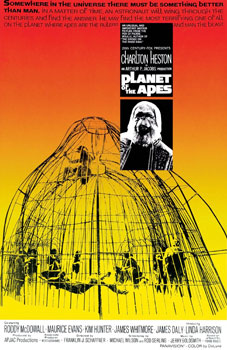
Originality! You cannot discount the sheer originality of Planet of the Apes. The costuming is amazing. The drama–if you can get past the the fact that it’s a ’60s movie–is really good. The imagery is so iconic. The twist ending (conceived by The Twilight Zone writer Rod Serling, not the author of the original book) is so well executed. If I have one complaint, it’s that I don’t think the ending wraps up the story very well. Which is a shame, considering the film that followed…
My rating: A+
Beneath the Planet of the Apes (1970)
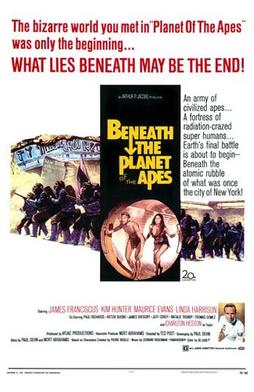
Evidently, Rod Serling came up with a concept for a sequel to Planet of the Apes, but his idea was discarded in favor of…this. Beneath is an outright terrible movie. Its structure hinges on a complete retread of the first film, and everything original it brings to the table is bizarre and silly. Charlton Heston’s return feels shoehorned in, like Heston didn’t even want to be there. (And that’s because he didn’t.) It’s just bad. The only thing I like about the film is some of the set design.
Boy, I wish I could have seen that Rod Serling sequel.
My rating: F
Escape from the Planet of the Apes (1971)
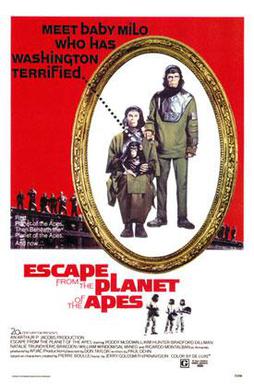
Cornelius and Zira carry this movie. The budgets for the Apes movies got slashed more and more with each new entry, and it starts to show in this film, where…honestly…not a whole lot of stuff happens.
It’s slow and much of it is a bit silly, but there are parts I like. It’s just a shame it couldn’t have been faster-paced or rewritten to show or emphasize the more interesting parts of the story. For instance, why do we not get to see the actual escape from the planet of the apes rather than skipping straight to the apes’ safe arrival? (Answer: low budget.) Really, the whole plot of this movie could have been an extended prologue to the next sequel.
The baby chimps are adorable, though.
My rating: C
Conquest of the Planet of the Apes (1972)
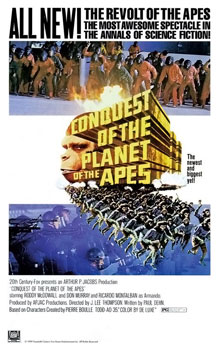
The film with the most similar premise to Rise, Conquest is definitely the most original of the sequels. In the near-future world of “1991,” a plague has wiped out all the dogs and cats, for some reason, leading people to take up apes as pets–a practice that has evolved into cruel ape servitude. Baby Caesar has grown up and is hunted by men concerned that the thought-to-be-assassinated child of Cornelius and Zira may have survived and will bring about the end of human domination over their ape-slaves.
It’s faster paced than Escape, but still a bit silly. (That dog and cat plague is just…too much.) Caesar leads an ape rebellion which is pretty cool, although we don’t get to see very much of him preparing the apes for it. (Lots of “Caesar the shoulder devil” shots, though.) Much of the dialogue is corny, but some of it is profound. Ultimately, the lower budget robs this sequel of scope, which is a shame; the entire film feels like it takes place all in one city block, and it gets a bit old by the end. It’s also a shame that the theatrical ending was poorly redubbed from the original, darker version. Having seen both endings, I wish they had gone with a blend of the two: Lisa (Caesar’s ape girlfriend) telling Caesar “no,” the ape crowd awaiting Caesar’s command, and Caesar staring off thoughtfully and silently as the camera pulls out.
My rating: B
Battle for the Planet of the Apes (1973)
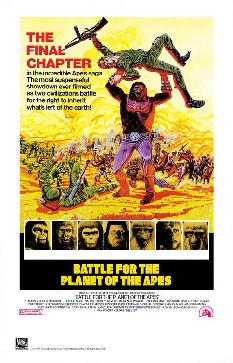
The final film was made on the lowest budget of them all–just under $11 million, when adjusted for inflation–and if it showed a little bit in the previous movies, boy does it show here even more. Low budget is probably its greatest downfall. It’s not a terrible movie, but it’s just so limited, so cheap and amateur in so many ways, and it has, like, two exciting action scenes. All of the characters are either lousy or just not-as-good versions of characters from the previous films.
Rather forgettable, unfortunately, although I do like how they tried to end on a hopeful note, with hints that it’s possible humans and apes may be able to learn to coexist peacefully and the destructive future may be averted.
But those nuke-worshipping mutants are still lame.
My rating: D+
The Apes Rise
There was also a remake of the first film in 2001, but I haven’t seen it in ages and it wasn’t very good. I suspect I would give it a “D-” at best.
So, none of the original sequels matched the quality of the first film. How can a series survive under such conditions? How much will fans put up with before they stop caring? The movie canon got messy right away with the whole “Earth exploding” thing in Beneath, which necessitated time travel to ever continue the story, and the rest of the sequels had to live underneath that shadow. I feel that if I were tasked with helming a reboot, I would have been pretty intimidated.
But the good news is, the new trilogy, beginning with Rise, was amazing. All of that silly and unnecessary stuff from the previous films got wiped clean with this new series, which takes a different approach to the premise of intelligent apes coming to prominence. It goes for a more realistic tone and isn’t beholden to the old series, while still drawing inspiration from it in appropriate ways.
Slow Burn
Andy Serkis stars as Caesar in ape “makeup” that is now accomplished with motion-capture technology provided by WETA Digital. In fact, with few exceptions (although I can’t verify which exceptions those are, considering how good the CGI is), every ape in the movie is computer-generated.
One of the first things that sticks out to me about this film is its slower pace. I’m always impressed by any movie made these days that is willing to–or I would even say dares to–be slow-paced when the story calls for it. So many movies today just refuse to move at any rate slower than breakneck speed, and while that isn’t bad in and of itself, it sometimes damages the quality of the story. Besides, there’s just something nice about a movie that doesn’t yank you forward on a chain for two hours straight.
Old movies, such as the original Planet of the Apes, were slower paced, and I tend to find that charming, even endearing, when it’s done right. With Rise we had a movie that knew it needed to be a “slow burn.” They resisted the temptation to move too quickly to the action and the apes speaking (something that I’d say the entire trilogy is pretty good with).
Will Rodman is a chemist working on a special virus intended to cure Alzheimer’s disease through brain cell repair. The cognitive-bolstering virus is tested on chimps, and one of them has a child–Caesar–who Will takes under his care when the project is shut down. Caesar is no ordinary ape, however, and Will quickly discovers that the chimp inherited the intelligent traits his late mother was beginning to develop before the project’s shutdown. The virus doesn’t just repair brain cells: it makes them stronger.
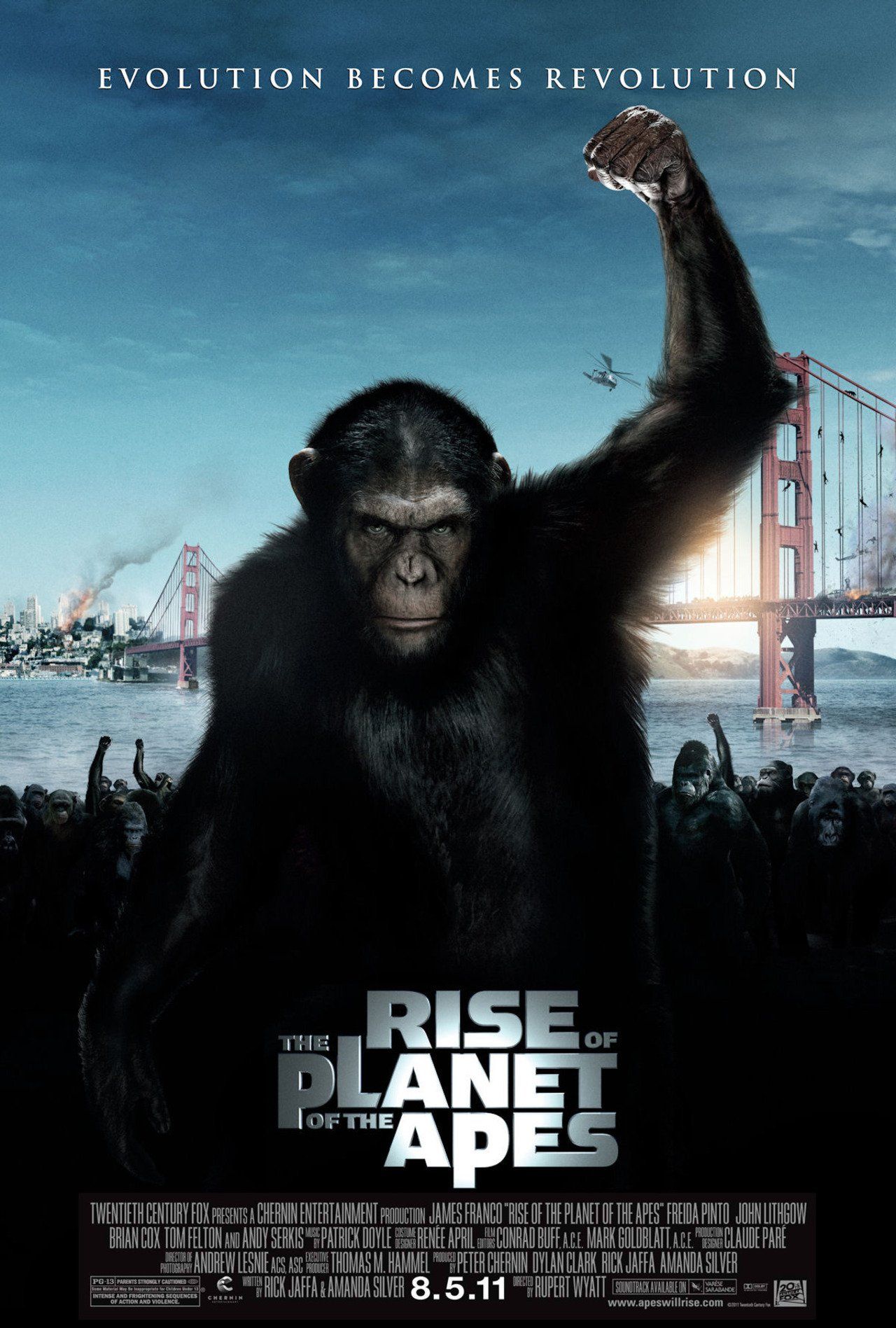
Caesar goes on to become increasingly intelligent, rivalling humans such that he becomes aware of a serious dilemma: the subjugation of his own race.
When I talk about the slow burn, I mean that Caesar doesn’t even appear until nearly ten minutes into the film, and isn’t much of a communicative character until fifteen/twenty minutes in or so. You’d be forgiven for thinking that Will Rodman was the main character, when really he’s secondary to Caesar. The first act is protracted, but feels necessary; as we grow up with Caesar, we really become attached to him. Without that long introduction before we get to Caesar interacting with and then becoming leader of the other apes, we wouldn’t feel for him like we’re supposed to.
Caesar’s happy-go-lucky upbringing comes crashing down when he’s put in an ape shelter and mistreated both by the other apes and by one of the animal handlers. It’s impressive how very believably Caesar transforms from a homesick, uncertain “youth” to a hardened, tough, and wise leader who is capable of putting himself on top of the ape hierarchy and sneaking his way out of his cage.
What the slow burn does is make the eventual release all the more epic. The final 25 minutes of the movie are explosive; after learning hard lessons about the reality of human domination and animal subjugation, Caesar has become wise and intelligent enough to enact a revolution, using the ALZ-113 virus to bring his ape followers the gift of smarts.
I still remember being in the theater for the “No!” scene, when Caesar finally stands up to his handler’s abuse and begins an effort to free all the apes. Every single time I watch that, I get goosebumps. It’s incredible. It ranks among the top ten most jaw-dropping moments in cinema for me. It’s partly thanks to the slow burn, but of course, more credit is due to Andy Serkis’s stunning portrayal of Caesar as well as WETA Digital’s equally stunning visual effects work to bring the apes to life.
Sympathetic Caesar
Caesar is a great character, one of the best things to come out of the original Apes series, so I think it was a great decision to utilize him in the reboot trilogy.
It’s relatively subtle, at least at the beginning, but Caesar goes through great character development in this film. I think I sense subtlety because I for one always end up surprised by just how much I empathize with Caesar in the second and third acts when he’s taken away from his home and family. It’s so sad to watch his downfall!
The carefree stage of his youth in the first act shows a few small signs of trouble to come–small conflicts with neighbors and the like. We see how he develops in intelligence, eventually questioning who he is. At that point Will has to reveal the truth about why Caesar is different, causing internal turmoil for Caesar and essentially beginning his three-movie-long character arc as he accepts his role as the ape emancipator.
I feel a lot of sympathy for Will Rodman, as well. From the first scene his drive to cure Alzheimer’s is strongly apparent. It’s poetically and bitterly ironic that his search for a cure to Alzheimer’s–the deterioration of the human mind–would inadvertently lead to the destruction of human civilization and the devolution of the human species altogether.
Lest I forget, only the best of praises can be given to each ape actor who portrayed their characters through motion capture. I can’t imagine the effort that would go into such a performance, and I salute them! The apes are totally convincing and so much fun to watch.
The human characters aren’t to be outdone, either. Will’s primatologist girlfriend, Caroline, and Will’s father, Charles, are welcome additions to the story. Charles, with his heart-wrenching mental deterioration, is a perfect visual reminder of why Will is doing what he’s doing, and his eventual refusal to continue the temporarily-successful treatment with the ALZ-112/113 helps spark Will’s turnaround.
Caroline is a smaller part of the story, but she is the other half of what sparks Will’s change of heart about using the ALZ-113 to manipulate nature. (Too bad it was too late, though.) It was good to have another character share in the secret of Caesar’s intelligence and support Will in the final act as he attempts to speak with Caesar.
Other human characters are good too. Steven Jacobs, Will’s boss, is a simple but memorable character. The surly neighbor is perfectly balanced between “hateable guy” and “guy you feel for.” And meanwhile Dodge Landon, the abusive animal handler, is perfectly and wonderfully hateable. There’s a great balance struck, in my mind, between sympathy for humans and sympathy for apes. You want the apes to win, but at the same time, you don’t hate all of the humans.
I remember feeling a bit confused when Will didn’t return in the sequel, but upon rewatching Dawn, I see that it’s clearly implied Will and Caroline did not survive the virus. One of the producers even confirmed their unfortunate fate in an interview. Gah, I feel so sad for them…
Caesar’s Home

As far as reboots go, this one is top-tier. I haven’t personally seen a better reboot film. The special effects are remarkable, the slow pacing is dramatic and cathartic, the human characters are good, and Caesar and the other apes are utterly captivating.
It’s no wonder that it led to two successful sequels continuing Caesar’s story. If there’s one complaint that could be made about the film, it’s that for a newcomer to the franchise, this film might not quite prepare them for just how grim and sad the series becomes in the next two entries. Rise ends on a tease that a deadly pandemic has begun, but I doubt that watching most of Rise, many people were prepared for the next two films to literally be post-apocalyptic tragedies for everyone but Caesar’s apes. Some might understandably have suffered some whiplash from that from Rise-to-Dawn!
But ultimately, as sad as the Planet of the Apes reboot movies are, it is not excessive (as it was in Beneath the Planet of the Apes, which literally ends with the Earth exploding. Can’t get much more depressing than that). It only fulfills the promise of the premise.
What’s even smarter is that it doesn’t pin the blame for Man’s downfall on any one person. Caesar started a revolution, but he didn’t create the ALZ-113 virus, nor did he spread it. Will created the virus, but he called upon Jacobs to stop testing (to no avail) and wasn’t responsible for Patient Zero (zoologist Robert Franklin) becoming accidentally exposed to the virus during testing. And even Robert Franklin wasn’t entirely responsible for the surly neighbor approaching him when he was contagious.
Had they made Caesar somewhat responsible for the downfall of humanity, it wouldn’t be possible for us to completely view him as the hero that he is in this and the next two films.
The previous Apes movies were fun and charming (when they were good), but it was so great to see this new reboot trilogy take the series in a more realistic/plausible direction with more drama and appropriate action. As great as Roddy McDowall’s Caesar was for those films, Andy Serkis’s Caesar leads with gravitas and might, only becoming better in the sequels.
I remain an #ApesFan4ever, eagerly awaiting the next entry in the franchise. 😀
My rating: A
 arcreonis.com