
NOTE: Full spoilers for the book contained below.
In the interest of gnawing away at my own boredom, I thought it would be interesting to write commentary on my novel, Cultivation. (As a new self-published author, pretty much everything I do here on the site is to satiate my own boredom until anybody else with interest shows up.) So I’m going to commentate on my own chapters one at a time, sharing whatever insights and interesting tidbits I can drum up.
I strongly do not recommend reading my commentary before reading the book in its entirety, as spoilers will abound, and generally I believe a book is best enjoyed first without the curtain halfway pulled back.
Without further ado, here begins my commentary on Cultivation, beginning with Chapter 1.
I sometimes do scraggly sketches of my main characters when I start a manuscript so I can better visualize them. These are my initial (and only) sketches for Leonard Marsh, Essie Marsh, and Julia Perez. For some reason, I did these on my phone with my finger. Probably because they were intended purely for my own reference. They’re, uh, not all that great, nor are they incredibly representative of the characters, but it was a start.
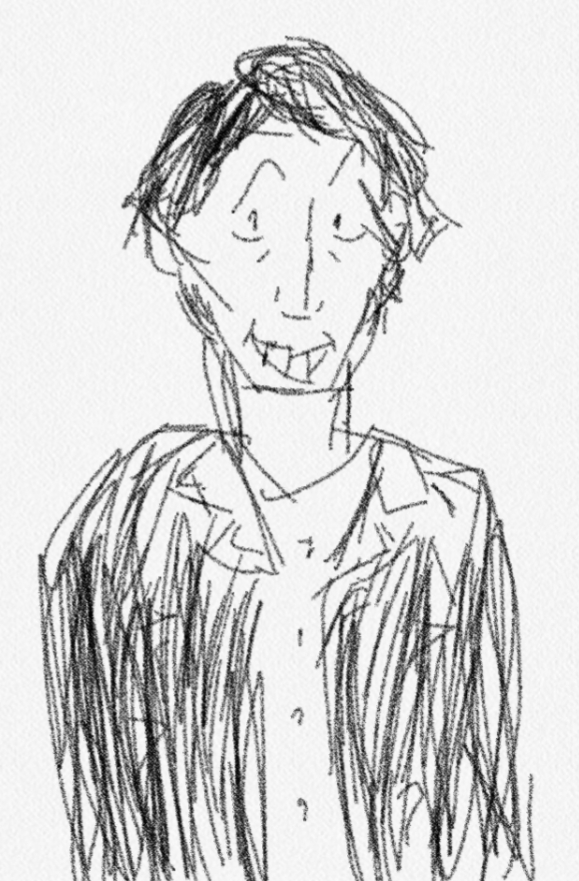
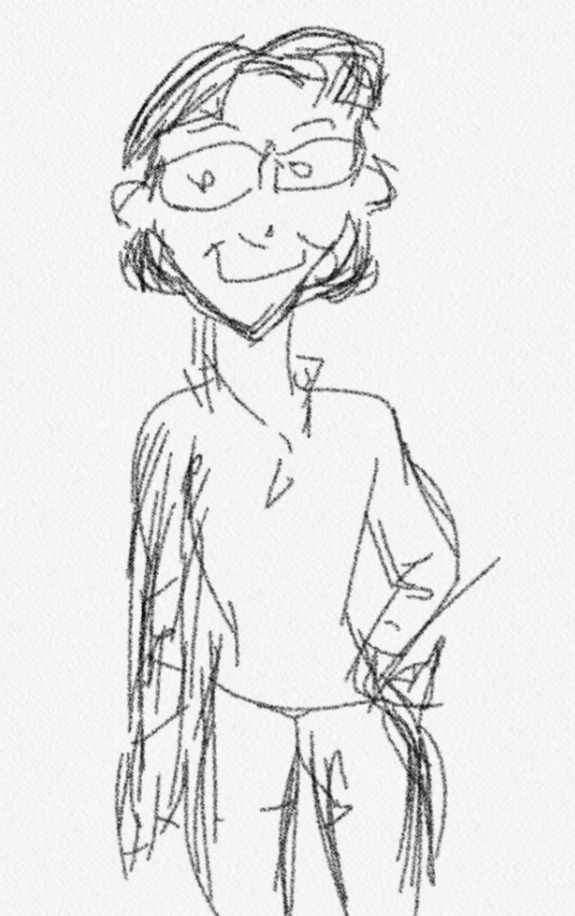
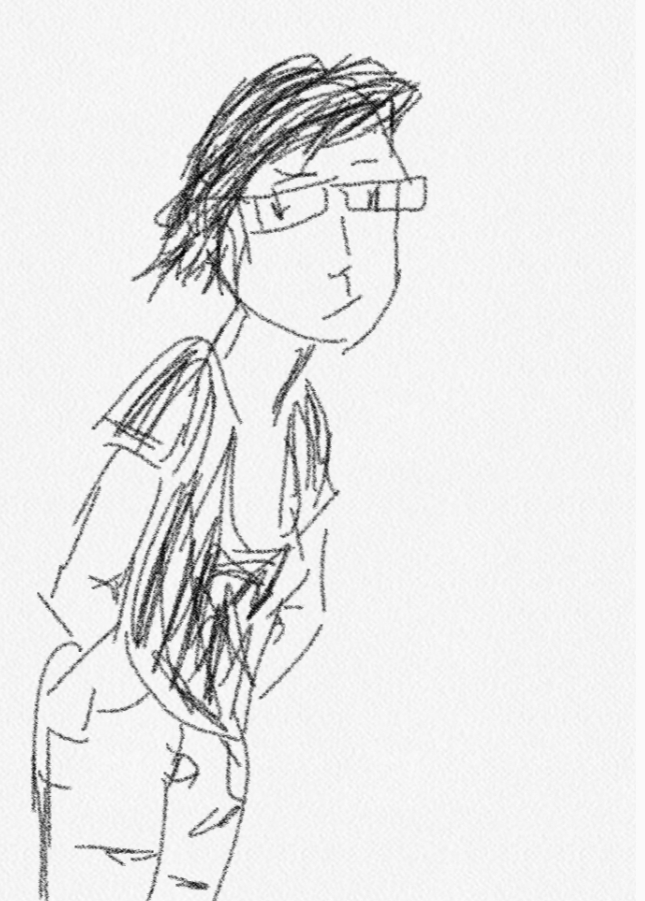
Essie’s name was inspired by the lead actress in the film The Babadook (Essie Davis). The family’s last name of “Marsh” could conceivably have been a reference to Beverly Marsh, one of the main characters in It, only it isn’t. I didn’t watch the movies until after I’d started Cultivation and named the characters.
“Another friendly welcome, Dennis,” Leonard said, stepping forward to clasp his brother in a wide hug.
The chapter originally started with Leonard and family on the road, but it felt too abrupt a beginning. I came up with the meeting at Uncle Dennis’s house as a way to introduce the foreboding worries about Maxine in a conversational way rather than a merely introspective (and rather sudden) way.
The first draft version of the scene stopping at Uncle Dennis’s house was less creepy. He says something that potentially outs him as part of the conspiracy–not explicitly, but just enough to make you wonder–and that was where it was left at. But I got (correct) feedback that the beginning was just too pedestrian, like a family drama instead of a horror story, so his possibly good name got sacrificed to the cause of making the book begin with a stronger promise of tone.
I certainly do think it works better. His solicitations to Julia and attempt to separate her from her parents distinctly mirror and foreshadow what happens throughout the book.
I could have gone further with the notion of starting the book with a bang–maybe had a prologue showing something evil happening at FDU. But I wanted it to be a bit of a slow burn where you aren’t quite sure what to expect. The horror of the U couldn’t just get blown open right at the start.
* So I just stopped by your house and you weren’t there. Thenn I checked my messages and realized why lol
* omg…you’re a bit forgetful today, Tammy.
Conversations with Julia’s text-friend Tammy were also added later, and they took a good number of revisions to feel remotely realistic. Hopefully it landed in a decent spot.
Essie turned on the radio, and a song began to play. “Blinding Lights” by The Weeknd. Julia let herself forget about Phil and start humming absently to the tune instead.
I eventually chose “Blinding Lights” by The Weeknd as the song for the radio partly due to its lyrics, a few of which felt thematically relevant enough that I stuck them in the page, and partly because it was rated as one of the top songs of 2020. Popularity, conformity, and evil deliberately hiding behind those two things are major themes of the book.
The latest and greatest example of that was completing her first two years of college at FDU. . . .
Until she came back for Christmas, and things went back to normal for about a week. . . .
The same process essentially repeated when she returned home for summer break between her freshman and sophomore
years. . . .That was the last in-person memory Leonard had of his elder daughter, nearly a year and a half ago.
It took a surprising amount of effort to nail down the timeline perfectly. Some major timeline goofs were kept in the manuscript for way too long, and I waited until a much-too-late hour to actually sit down and plot out the full timeline for all the family events. One thing I learned: don’t save that stuff for super late in the process. Thankfully it’s all squared away now.
Leo remembered a few phone calls in the ensuing months keeping them connected. She needed them still, and they found they
still needed her.Then, at some point, it stopped.
Essie had gone into a panic, and Leonard soon became convinced to worry too. When Maxine didn’t respond to messages or calls, they called her friends and asked for her. They wrote the school. Still, there was nothing.
This third paragraph was an important addition based on feedback I got from actual mothers of college-age children. Their suggestions for what they would do if their young adult child dropped off of any communication was helpful for a sociopath like me to write Essie in such a way as to make her feel like a real mother.
Let him chuckle. He [Leonard] was just coping with the prospect of losing his last daughter.
I’ve found lots of things like this in my writing–apparent examples of thematic foreshadowing that really were not intentional, but make sense given the fact that the story was written in an attempt to be narratively and thematically cohesive. I’m always happy to find it.
Julia swallowed. She felt her eyes drifting to the graveyard—the only piece of the town she’d seen so far that looked wholly run-down and left to decay—for a moment.
Delton does not care for its past.
One heavy-set man with an unbuttoned shirt and jeans sat on one of those lawn chairs with a near-empty wine glass in hand, beside another man of shorter stature and thick spectacles. Both stared up at the sky. The shorter of them drank the last of his wine and got up to go inside, but stopped and turned to the heavy man as if to offer a refill. The heavy man raised a palm, as if to decline.
This is one of the first examples of the “running low” motif I put throughout the novel, often coupled with “declining a refill.” An attempt to symbolically drive home the themes of cultural decay and rejection.
[1] [2] [3] [4] [5] [6] [7] [8] [9] [10] [11] [12] [13] [14] [15] [16] [17] [18] [19] [20] [21]
 arcreonis.com
2 thoughts on “Cultivation Commentary – Chapter 1: “navigation””