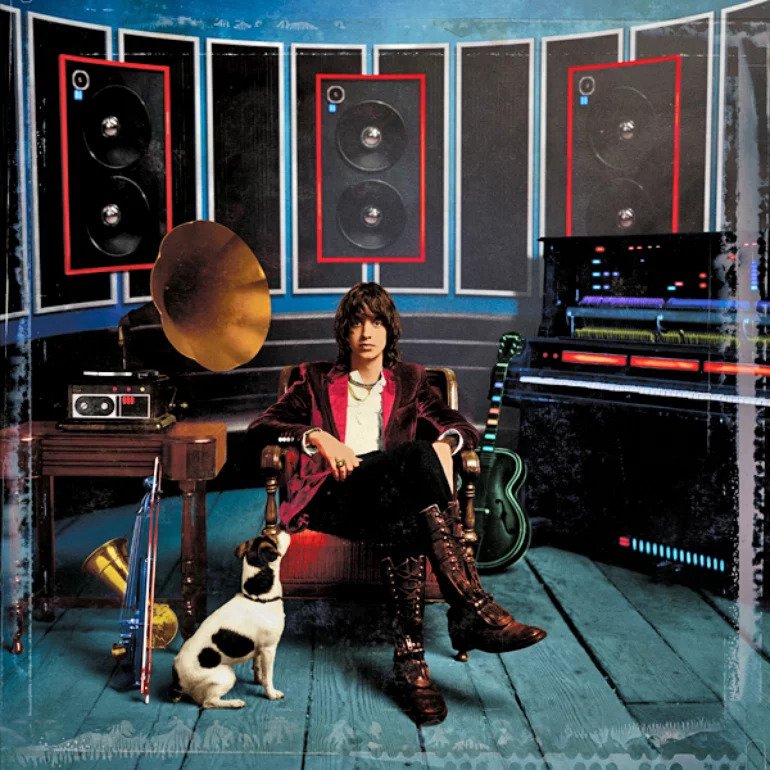
I liked and appreciated some songs that came out before this, but Phrazes for the Young is the first album I ever adored, and the one that made me realize music could be amazing and emotionally resonant. (Yes, I know I’m young. I guess the album was aptly named.) I hardly ever listen to its songs anymore, to be honest. To me the album is emblematic of my early teenage youth, and the fact that I thought it would always be my “favorite thing ever” is equally emblematic of the process of growing up and the changing tastes and interests and mentalities that I never imagined would happen to me.
It came out just before I turned 13, at the perfect time for my over-imaginative little brain. “11th Dimension” became my favorite song and music video. “If you believe in this world, then no one has died in vain” has stuck with me forever. I also really loved “Tourist” with its desolate wandering–“Everywhere I go I’m a tourist, but if you stay with me I’ll always be at home.” My first ever concert experience was seeing Julian live in NYC with my older brother (who introduced me to the band).
I jumped back into the older Strokes albums, loved them, and eagerly awaited their next project. From then on, it seemed like Julian Casablancas somehow possessed some mystical ability to tap right into my brain and say the things I was thinking even as I aged awkwardly through the teenage years. The haunting, elective loneliness of “Chances.” The devastating, crushing loss of “Instant Crush.” I wonder if it would be an exaggeration to say his music enabled me to process my own feelings.
In 2014, I was nearly graduated from high school, and my life was nearing its lowest point. That’s when Julian (with his new band, “The Voidz”) released Tyranny, and it happened once again. “Human Sadness”–an epically emotional 11-minute beast of a song built off a sample of Mozart’s “Requiem in D Minor”–broke me when I learned the lyrics, especially the ones that had to do with Julian’s own broken relationship with his then-recently-deceased father:
“The moon’s a skull, I think it’s grinning
The room is full of people now I think it’s spinning
Wanted you, didn’t ask for nothing
Wait for you on and on
And I don’t need your tie, I don’t need to, tired of saying it
We don’t need more talk, don’t empty out your canteen on the desert floor
Ahhh, it’s all my fault . . .
“Not your son
Not your friend
Not your enemy . . .
“He’s not my son, search his home”
And apart from that, the beautifully sorrowful ruminations on life’s inevitable erosion and the weight of regret just hit me harder than practically anything else I’d ever heard up to that point:
“He wanted it more than me, I suppose
I was in a rush to wait in a line
Now I hear echoes of my old self
This is not the way to be
All at once
I lost my way”
And that contrasted with the surprisingly hopeful ending of the song:
“All is lost–
I’ll find my way
So I say
To be is not to be
To be is not the way to be”
I couldn’t dissect this ending better than this annotation from someone on the Genius website:
“To me, this is a reference to the most famous quotation from Shakespeare: ‘To be, or not to be, that is the question’. The question is whether to live – to be – or not to live – not to be, i.e. suicide. Julian is responding to his own depression with a rejection of that dichotomy and a message of hope. He doesn’t have to choose whether to live this life or commit suicide, he can choose to change his life; he will continue to be, but not in this manner of living, because this is not the way to be. He will change himself and change the world for the better. It’s the moment of hope in a song fundamentally about depression, both personal and on the level of humanity. The choice isn’t acceptance of the world or rejection as Hamlet thought, but rather the third option: live and change things for the better.”
And of course that’s to say nothing of the other great songs on that same album. Suffice to say when I think of 2014, I think of Tyranny.
Time passed, and I hit the lowest years of my life. I became what I might describe as “mentally absent” for a long time. If you asked me, I’m not sure I could even tell you much about what happened then.
So I had been away from music for a while when I listened to The Voidz‘s next album, Virtue, and upon first listen I wondered if the magic was gone. Maybe I had outgrown it all. (To be clear though, I later returned to that album and came to love many of its songs, even if it’s not as emotionally resonant for me as some others.)
Then two more things happened. I don’t know in which order I listened to them, because I’m not sure I heard it when it released, but first in release order is “Did My Best” released by The Voidz in 2019. I might have listened to it a few times before it clicked with me, but when it did, it became my new favorite song. I don’t have time to dissect it here. Let me just say that its groovy melancholic retrospection hit me right in the heart. Like, DEAD center. Jules had done it again–maybe more than he ever had before.
In 2020 the Strokes released their latest album The New Abnormal, and it happened yet again–with “At The Door” and “Ode to the Mets” especially. I love that album to pieces.
Julian Casablancas and the rest of the Strokes are artists who seem to be on the same wavelength as myself. (The same weird, weird, wonderful wavelength.) The fact that I’ve continuously been able to indirectly connect with them through their music is a surprising gift I’ve always been happy for.
I’m doing a lot better now than I was several years ago, but I still possess little ability to process my own emotions and feelings. Having art to lend me that ability from time to time has made my life just a little bit better, and a lot more beautiful.
Thank you, Julian!
 arcreonis.com